A shoulder dislocation occurs when the upper arm bone (humerus) pops out of the shoulder socket (glenoid), causing instability and pain. The shoulder joint is highly mobile, making it more prone to dislocation compared to other joints in the body. Dislocations can be partial (subluxation) or complete, where the bone is entirely out of the socket.
Symptoms
Intense pain in the shoulder.
Visible deformity or shoulder appearing “out of place.”
Inability to move the shoulder.
Swelling, bruising, or tenderness.
Weakness or numbness in the arm, hand, or fingers.
Treatment Options
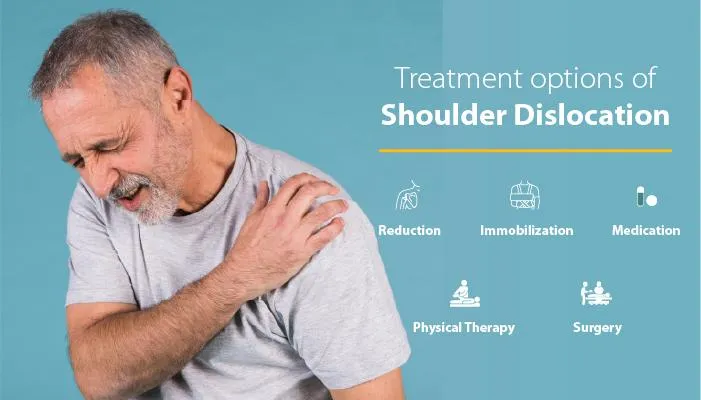
Closed Reduction : The doctor manually repositions the humerus back into the socket. This is often performed under sedation or local anesthesia.
Immobilization : After reduction, the shoulder may be immobilized in a sling for several weeks to allow healing.
Physiotherapy : Rehabilitation exercises are crucial to restore strength, range of motion, and prevent future dislocations.
Surgery : Recommended if there is damage to the surrounding tissues (labrum, ligaments, rotator cuff) or in cases of recurrent dislocations. Procedures may involve repairing torn structures or stabilizing the shoulder with techniques like the Bankart repair or Latarjet procedure.
Prevention Tips
Strengthen Shoulder Muscles : Focus on exercises that stabilize the shoulder joint.
Avoid Risky Activities : Minimize exposure to activities that might cause falls or direct blows to the shoulder.
Warm-Up Before Exercise : Proper warm-ups and stretching can help reduce the risk of shoulder injuries.
Use Protective Gear : In contact sports, wearing appropriate padding can help protect the shoulder.
Shoulder dislocation F&Q's
A shoulder dislocation occurs when the upper arm bone (humerus) comes out of the shoulder socket (glenoid). It can be a partial dislocation (subluxation) or a complete dislocation where the bone is entirely out of the socket.
Common causes include falls, sports injuries (especially in contact sports like football, rugby, or basketball), accidents, and trauma. Overhead activities or repetitive strain on the shoulder can also increase the risk.
Symptoms include severe shoulder pain, visible deformity, inability to move the shoulder, swelling, bruising, and sometimes numbness or tingling in the arm or hand.
A doctor will perform a physical examination and may use imaging tests, such as X-rays or MRI, to confirm the dislocation and check for associated injuries like fractures or torn ligaments.
Treatment typically starts with a closed reduction, where the bone is manually repositioned into the socket. This may be followed by immobilization in a sling and a rehabilitation program. Surgery may be needed in cases of recurrent dislocations or significant damage to surrounding structures.
No, surgery is not always necessary. For first-time dislocations, non-surgical treatment with reduction, immobilization, and physiotherapy is often effective. Surgery is considered if there is damage to the ligaments or labrum or if the shoulder dislocates frequently.